

Soil stabilization, Denver: stop the settling where it starts
A crack that keeps growing, a door that sticks, a floor that slopes: when a house settles, the cause is usually the ground under it. With soil stabilization, Denver homes are treated from below. We inject structural polymer into the weak soil beneath your foundation, with no digging, and it’s usually done in a day.
First, a free on-site assessment shows what’s really moving your house, and tells you plainly if you don’t need us.
- Licensed & Insured Contractors
- 40+ years combined experience
- No excavation
 Real Denver job A 1950s Denver home, stabilized in four hours Read the case study
 Cracks that are just concrete, and cracks that mean the soil moved
Not every crack is a foundation problem, and some of yours probably aren’t.
Concrete shrinks as it cures, and the thin lines it leaves usually stop there. Other signs mean the ground under the house has moved, and those deserve a closer look. Tap what you’re seeing at home, and we’ll sort it.
What you’re seeing
Tap each one you’ve noticed. Nothing you tap is sent anywhere.
All sorted. Tap any symptom to put it back.
Group 1
Concrete being concrete
Watch it, seal it, get on with life. Pencil a mark at each end and date it; if it hasn’t grown in a year, it’s done. More on hairline cracks
Nothing sorted here yet.
Group 2
The soil is moving
Part of the house is following the ground beneath it. A patch covers the sign, not the cause.
Nothing sorted here yet.
If your taps land in the second group, a free on-site assessment tells you why.
We test the soil under your foundation and show you what’s moving it, before anyone talks about a fix.
Sinking or swelling: Denver soil can do both
Colorado soil has a bad name, and some of it has earned it. Here’s the straight answer on soil stabilization: Denver ground can move a house in two opposite directions, and each one calls for a different fix.
The Colorado Geological Survey ranks swelling soil as the state’s most significant geologic hazard. Swelling clays lie under many of Colorado’s populated areas, though not under every house. The other Denver problem runs the opposite way: ground too weak or loose to hold the house up.
First fix: water, not injection
Swelling clay pushes up
Wet swelling clay can grow by up to 20% of its volume, and it lifts whatever sits on top: slabs heave and walls get pushed. Polymer isn’t the first answer to that. Keeping water away from the clay is.
- Gutters that carry roof water off
- Downspouts that empty well away from the house
- Ground graded to slope away from the walls
- Sprinklers aimed off the foundation
What polymer injection fixes
Weak soil lets it sink
Soil that’s weak, loose or poorly compacted, or has voids opening in it, can’t carry the weight above it. The footing drops and the wall follows. This is the problem injection is for: pushed through small probes with no digging, the polymer fills the voids, compacts the loose soil and raises the load the ground can carry.
Not sure which one is under your house? That’s what the visit is for.
From inside, both can look the same: a crack, a door that sticks. A free on-site assessment includes soil density testing under your foundation, so you know which problem you have before anyone quotes you a foundation repair, Denver company or not. If the answer is drainage, we’ll say so.
Ten feet down: a 1950s Denver brick home, stabilized in four hours
One real Denver house, in the order the work happened. It’s a single job, not a promise about every house, but it shows what goes on under a foundation when we stabilize one.
- 4 hours, start to finish
- 10 feet, depth treated
- No excavation
-
The house had started to settle
A brick house built in the 1950s, in a part of Denver where foundation settlement is a familiar problem. Its foundation had begun to sink, and the question was why.
-
Testing found weak soil to about 10 feet
Before any plan, we tested soil density with a dynamic cone penetrometer. It found weak, poorly compacted soil running about 10 feet below grade, and that set how deep the treatment had to reach.
-
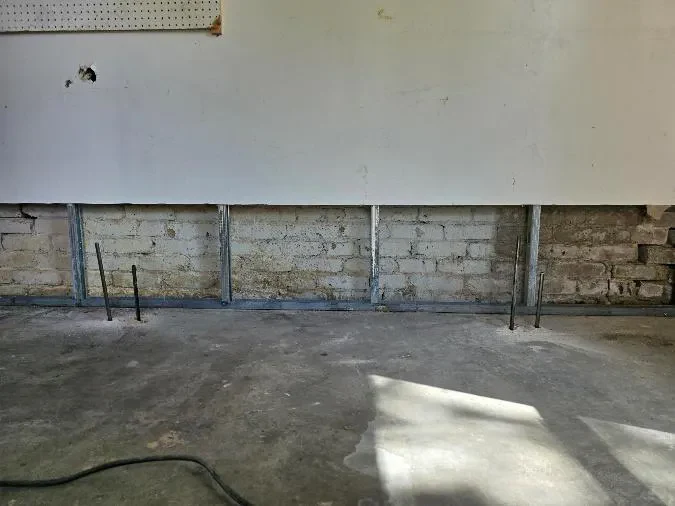
Probes 4 feet apart, each injected at two depths
The plan set injection points 4 feet apart along the stretch of foundation that had settled, and injected every one at two depths. The polymer expands into the weak layer, filling voids and packing loose soil tighter so it can carry more load.
The probes in place along the home’s brick foundation wall. -
Four hours, no digging, and the day went on
The installation team finished the full stabilization in four hours, start to finish. Nothing was excavated, and the homeowners’ daily life carried on around the work.
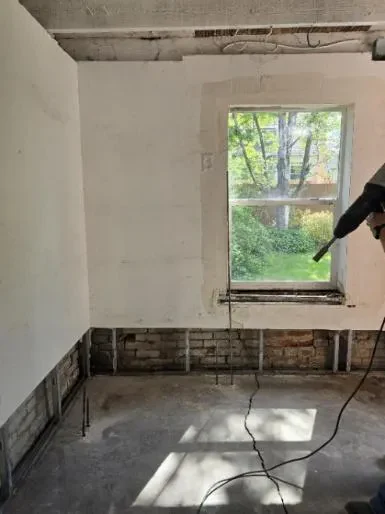
Same basement, during injection: the crack across the slab runs toward the wall.
Your house gets its own test and its own plan.
The depths, the spacing and the time it takes all come from testing your ground, and that testing is part of the free on-site assessment. Before anyone quotes you for soil stabilization, Denver or anywhere else, ask to see the test behind the plan.
Piers or soil injection: what each one costs you
Piers work, and if you’ve been quoted for them, that quote isn’t a trick. They carry the weight of your house down past the weak soil to firmer ground.
Where the two methods part ways is in what each one asks of you, and in what’s left under the house once the work is done.
| Traditional pier systems | Deep soil injection | |
|---|---|---|
| How it holds the house | Carries the load down to stable ground below the weak soil. | Firms up the weak soil itself: fills voids, compacts what’s loose, adds load-bearing strength. |
| Digging | Excavation around the foundation, with heavy equipment on site. | None. Small probes go in; lawn, flower beds and sprinklers stay put. |
| Time | One to two weeks. | A day or two. For most homes, one. |
| What’s under the house after | The same weak soil, now bypassed. | Treated soil, with a polymer that won’t shrink, break down or wash away. |
| Cost | The higher of the two. | 40–70% less than traditional pier systems. Where the savings come from |
Why there’s no price on this page
Your number depends on your house: how much of it needs treating, and how deep the weak soil goes. Testing on site answers both. The estimate is free, and you have it in hand before anyone starts work.
When injection isn’t the answer
A foundation that has structurally failed needs replacing, not injection. It’s the rare case, and if it’s yours, we’ll tell you. When a foundation needs replacing
What Denver homeowners ask before they book
Quick answers to the questions most people still have by this point. If yours isn’t here, call (855) 850-5625.
Does it last, or is it a stopgap until I pay for piers?
It’s meant to be the last repair, not a placeholder. Once cured, the polymer becomes part of the ground under your house, and the soil it compacted keeps its added load-bearing strength indefinitely. Piers work too, but they rest on deeper ground and leave the weak layer in place; injection repairs that layer. Done properly, the repair typically lasts as long as the home, and our work is backed by warranty.
You’re not a Denver company. Will anyone actually come out?
Yes. Denver is one of the four metro areas we serve, along with Chicago, Phoenix and Kansas City, and the 1950s brick home in the case study above is in Denver. Your free assessment happens at your property, where we test the soil’s density before any plan gets written.
Will my house come back toward level?
It can. As the polymer expands in the weak soil, your foundation rises back toward level, and we track that lift, along with how the soil is responding, in real time while we inject.
Can we stay in the house while you work?
Yes, and most homeowners do. Nothing heavy comes inside, the work isn’t loud, and nobody has to move out for it. Before we leave, we patch the small probe holes.
Is the polymer safe near my garden and water lines?
It carries NSF/ANSI 61 certification for drinking water. Once it cures, it’s inert and doesn’t leach. And since nothing gets dug up, your beds, lawn and sprinklers stay as they are.
It’s my driveway or patio that sank, not the house.
That’s a separate job from the foundation work on this page. Driveways, patios and walkways that have dropped are covered by concrete lifting.
What if it’s a commercial building?
Commercial buildings are a separate service, with their own page: commercial services. The first step is the same free estimate.
Find out what’s under your house
Ground that’s moving tends to keep moving. A crack that has stopped can simply be watched. A free on-site assessment tells you which one you’re living with.
Either way, you stop guessing, and finding out costs you nothing.
-
You get in touch
Send the short form or give us a call. Tell us what you’ve noticed and where the house is.
-
Someone comes out to look
We see the cracks and doors for ourselves and check the soil beneath your foundation.
-
You get a clear plan first
What’s moving the house, what would fix it and your estimate, before any work begins. If it only needs watching, we’ll say so.