Foundation repair · Littleton, CO
Foundation Repair in Littleton That Fixes the Soil Under Your House
A crack that keeps growing or a door that starts sticking usually means the ground under your house moved. We stabilize that soil from below with polymer injection. No excavation, and most residential projects are completed in a single day.
The free on-site assessment tells you plainly what is moving your house, including when you don't need us.
or call (855) 850-5625
- Licensed & Insured Contractors
- 40+ years combined experience
- No excavation
Before you call anyone
Is It a Foundation Problem, or Just Concrete Being Concrete?
Nearly every house cracks somewhere. Here is what Littleton homeowners tend to notice, and how to tell which of it matters.
- Thin hairline cracks in a basement wall or slab
- A crack that hasn't changed in a year
- A crack that's wider than it used to be
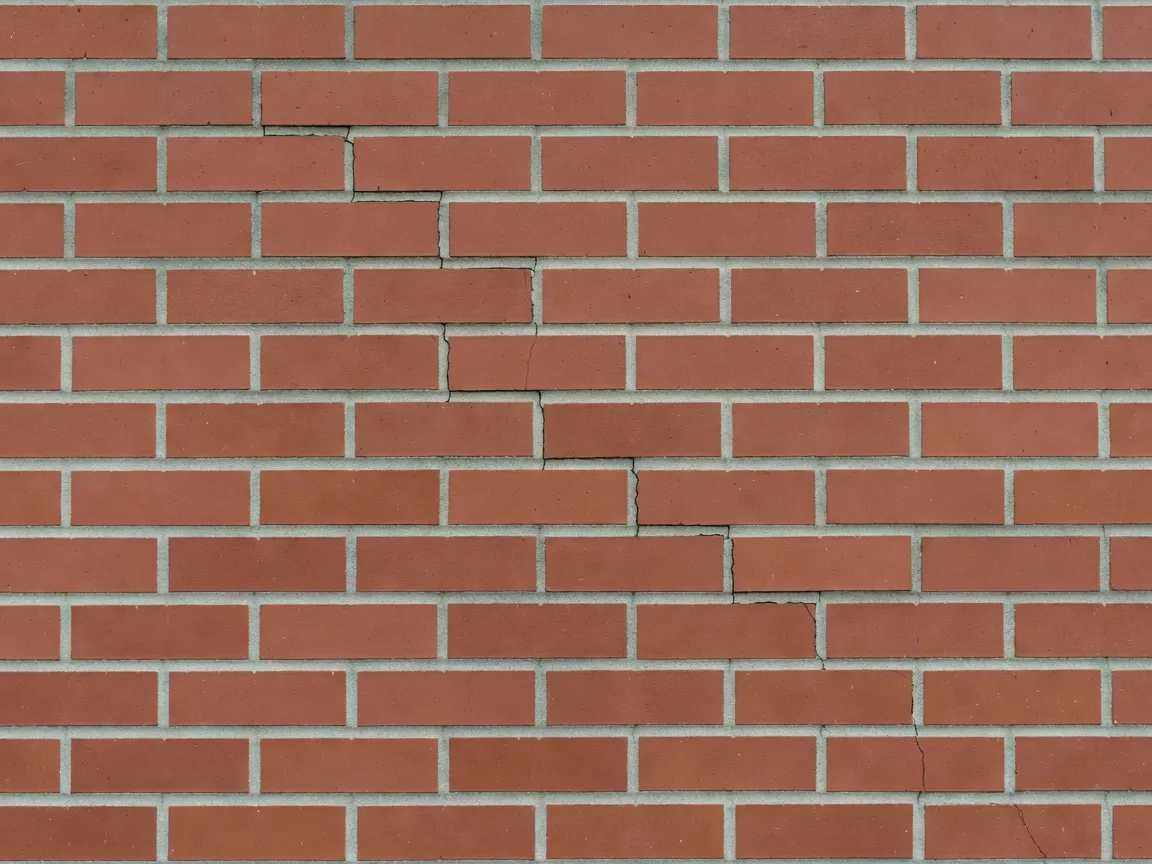
- Stair-step cracks in exterior brick
- Doors or windows that started sticking
- Floors that slope
- A crack that came back after you patched it
The first two are concrete being concrete. Concrete shrinks as it cures, and almost every home gets thin cracks from it. Seal them to keep water out, mark the ends with a pencil and the date, and watch. No repair needed.
The last five trace back to the soil under your house moving, and those are the cracks that tend to keep going. They are worth a look from someone who tests the soil before quoting a fix.
Still not sure? Here is how to tell a stable hairline crack from a progressive one.
Seeing any of the last five? Get a free estimate or call (855) 850-5625.
Holding a pier quote?
Got a Pier Quote? Here's What Each Fix Does to Your House
Piers work. They carry your house past the weak soil to deeper, stable ground. Deep soil injection works from the other side: it firms up the ground your house already sits on. Same goal, very different day for your yard.
Pier job: trench along the foundation Soil injection: probe points, yard left alone
Pier job: trench along the foundation Soil injection: probe points, yard left alone
| Pier job | Soil injection | |
|---|---|---|
| How it fixes the house | Bypasses weak soil by driving piers through to stable ground. | Small probes inject polymer that fills voids and stabilizes the loose soil under the foundation. |
| Your yard | Requires excavation around foundation perimeter. | No trench. A row of small probe holes, and the lawn and beds stay. |
| The weak soil | Stays where it is. The house stops resting on it. | Treated and firmed in place. |
| Cost | The higher of the two. | Typically 40–70% less than traditional pier systems. |
Piers are a sound repair, and we won't tell you otherwise. They simply cost more, need the digging, and leave the weak soil where it is. With injection, most residential projects are completed in a single day.
Three questions to ask any contractor before you sign
-
Did you test the soil, and how deep?
A fix chosen without knowing where the weak soil is, and how far down it goes, is a guess.
-
Does this plan fix the soil, or go around it?
Both can be sound repairs. You should know which one you are paying for.
-
How much of my yard gets dug up?
Ask for it in feet of trench, and what happens to the lawn and beds afterward.
Holding a pier quote? Get a second look at the soil before you sign.
or call (855) 850-5625
One real job, just up the road
Up the Road in Denver: A 1950s Home Stabilized in Four Hours
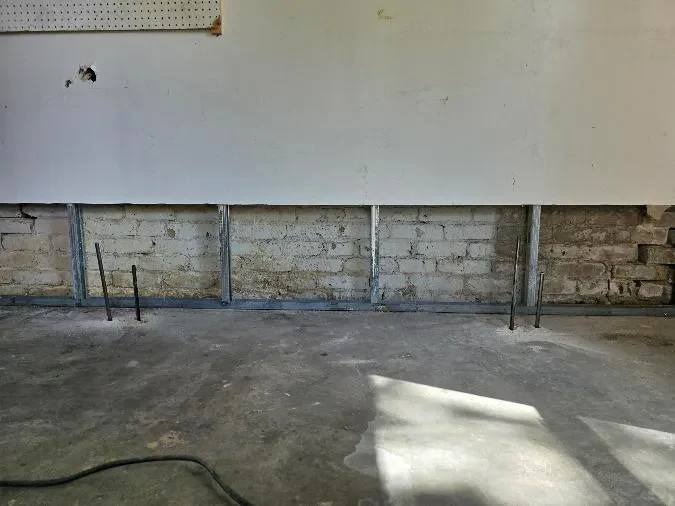
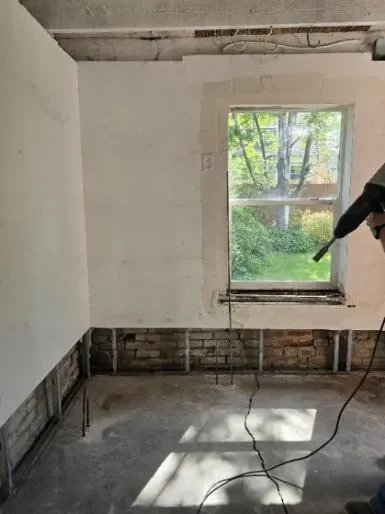
The Denver job: probes set along the settled brick basement wall, each one injected at two depths.
A 1950s brick home in Denver had started to settle. The crew ran a soil-density test that measures how firm the ground is at each depth, and found the cause: weak, poorly compacted soil about 10 feet below the surface.
So that is where the polymer went. Injection points were spaced 4 feet apart along the settled wall, and each point was injected at two depths. The foundation was stabilized in four hours, with no excavation, and the homeowners carried on with their day.
- start to finish
- 4 hours
- down to the weak soil
- 10 ft
- no excavation, no disruption
- No digging
Why it matters in Littleton: about 3,000 homes here were built in that same decade, the 1950s.1 That is a fact about age, not about the ground under them. Your house gets its own soil test.
This is one job, not a promise about every house. It shows what the method does when weak soil is the cause.
Read the full Denver case study
1. 3,051 homes in Littleton city built 1950 to 1959. US Census Bureau, American Community Survey 2024 5-year estimates, table B25034.
What actually happens
How Foundation Repair Works at Your Littleton Home
You don't need to know anything about foundation repair. Littleton or anywhere nearby, it starts the same way: one free visit to find out what is going on. If it is weak soil, one working day to fix it from below. Here is each step, in order.
- Most homes
- One day
- While we work
- You can stay home
- Digging
- None
Free The visit
-
We come to your house
A free on-site assessment at your Littleton home. We look at the cracks, doors and floors you have noticed, tell you plainly what we think is moving the house, and give you an estimate. If it isn't the soil, we say so.
About a day If you go ahead: soil tested first
-
We test the soil
Before anything goes in the ground, a soil-density test measures how firm the ground is under your foundation, depth by depth, and finds the weak zones and how deep they sit.
-
We plan for your house
From those readings we set a custom injection plan before the first probe goes in: the exact spots along the foundation and the depths each one needs.
-
Small probes go in, no digging
Small injection probes are driven to those predetermined depths beneath the foundation. No trenches, no excavator, no torn-up yard or landscaping.
-
The polymer fixes the ground
High-density polymer fills voids and compacts loose soil so it can carry the weight of the house again. As it expands it lifts the foundation back toward level, with lift monitored in real time.
-
We check it and patch up
A final inspection confirms the result. The probes come out, the small holes are patched, and your home is ready to use.
The question everyone asks
What Foundation Repair in Littleton Costs
We don't publish a price. Nobody can give you an honest number for foundation repair, Littleton or anywhere else, over the phone. Yours depends on the ground under your house.
Two things set your number
-
How deep the weak soil goes
The probes have to reach the weak layers, however far down testing finds them.
-
How much area needs treating
One settling corner is a smaller job than a whole wall line.
The free visit gives you an estimate from what we see on site. If you go ahead, soil testing comes first and maps both before anything goes in the ground.
Compared with piers
Typically 40–70% less than traditional pier systems
Most of the saving is the digging we skip: no excavation, no heavy equipment, no yard to rebuild.
If it's water, it costs less still
Sometimes the soil isn't weak, it's wet. If gutters, downspouts or grading are behind the movement, fixing the drainage costs less than injection and may be all you need. We'll tell you that at the visit.
Your actual number, from a free on-site assessment. Or call (855) 850-5625
Before you book
Littleton Foundation Repair Questions
The things Littleton homeowners ask us before the visit, answered plainly.
You're not based in Littleton. Will anyone actually come out?
Yes. Littleton is part of the Denver metro, one of the areas Stratalock serves. So if you need foundation repair, Littleton, CO is covered, and the free on-site assessment happens at your property, not over the phone.
Colorado clay swells. Doesn't that push houses up, not down?
Sometimes. The Colorado Geological Survey ranks swelling soil as the state's most significant geologic hazard. Swelling is a water problem, so drainage is the first fix. Polymer injection is for weak or loose soil that lets a house sink. More on how Denver-area soil can move a house both ways. Not sure which one you have? The free on-site assessment looks at it and tells you whether it's swelling, weak soil or neither, and if it isn't something injection fixes, we say so.
Is polymer injection a real repair, or a stopgap before piers?
A real repair. The polymer fills voids and compacts loose soil, and it won't shrink, degrade or wash away. It becomes a permanent part of the soil mass under your foundation.
Will my house come back toward level?
It can. As the polymer expands it lifts the foundation back toward level, and we monitor the lift in real time while we inject.
Can we stay home while you work?
Yes. There is no excavation: we work through small probes, and the probe holes are patched before we leave. Most residential projects are completed in a single day.
It's my driveway or patio that sank, not the house.
That's a separate job from foundation work: concrete lifting raises sunken concrete slabs such as driveways, patios and walkways. If the soil under the slab is what keeps giving way, soil stabilization in Denver covers firming up that ground.
Something else on your mind? Ask it at your free estimate, or call (855) 850-5625.
Free on-site assessment
Find Out What's Moving Your House
One visit tells you what's behind the crack, the sticking door or the sloping floor, and what it would take to stop it. It costs you nothing.
- The soil Weak layers we can stabilize from below, usually in a day, no digging.
- The water Gutters, downspouts or grading, a cheaper fix we'll point you to.
- Just concrete Normal shrinkage cracks. If you don't need us, we'll say so.
or call (855) 850-5625